
Regulatory Compliance, Uncategorized
What is CJIS 6.0? Understanding the Latest FBI Security Policy Update
Introduction
If your organization works with criminal justice data, you’ve likely heard about CJIS 6.0 — the latest update to the FBI’s Criminal Justice Information Services (CJIS) Security Policy. But what exactly is CJIS 6.0, and what does it mean for your agency or business?
In this post, we’ll break down everything you need to know about CJIS 6.0, including what changed, who is affected, and how to ensure your organization stays compliant.
What is CJIS?
The Criminal Justice Information Services (CJIS) Security Policy is a set of security standards established by the FBI to protect sensitive criminal justice information (CJI). It applies to any agency, organization, or vendor that accesses, stores, transmits, or processes CJI — including law enforcement agencies, courts, corrections facilities, and their technology partners.
The CJIS Security Policy has been regularly updated over the years to keep pace with evolving cybersecurity threats and technology advancements.
What is CJIS 6.0?

CJIS Security Policy Version 6.0 is the most recent major revision of the FBI’s CJIS Security Policy framework. It introduces updated requirements across several key security domains to strengthen the protection of criminal justice information in an increasingly complex threat landscape.
CJIS 6.0 aligns more closely with modern cybersecurity frameworks — including the NIST Cybersecurity Framework and Zero Trust Architecture principles — reflecting the FBI’s commitment to staying current with industry best practices.
Key Changes in CJIS 6.0
CJIS 6.0 introduces several notable updates that organizations need to be aware of:
1. Enhanced Multi-Factor Authentication (MFA) Requirements

CJIS 6.0 expands and clarifies MFA requirements, making it mandatory for a broader range of access scenarios — including remote access, cloud environments, and privileged accounts. Organizations must ensure that all users accessing CJI are authenticated using two or more factors.
2. Alignment with Zero Trust Principles
The updated policy reflects a shift toward Zero Trust Architecture (ZTA), which operates on the principle of “never trust, always verify.” This means organizations must continuously validate users and devices rather than relying solely on perimeter-based security controls.
3. Cloud Computing Guidance
As more agencies move to cloud-based solutions, CJIS 6.0 provides clearer and more comprehensive guidance on how cloud services can be used to store and process CJI — including requirements for cloud service providers (CSPs) and how they must meet CJIS compliance standards.
4. Updated Encryption Standards
CJIS 6.0 updates encryption requirements to reflect current NIST standards, ensuring that data at rest and data in transit is protected using modern, approved cryptographic algorithms.
5. Incident Response and Reporting
The policy strengthens requirements around incident response planning, including clearer timelines for reporting breaches and security incidents that involve CJI.
6. Mobile Device Management (MDM)
With the widespread use of mobile devices in law enforcement, CJIS 6.0 places greater emphasis on mobile device security — including device encryption, remote wipe capabilities, and application management.
Who Does CJIS 6.0 Apply To?
CJIS 6.0 applies to any entity that accesses or handles Criminal Justice Information, including:
- Law enforcement agencies (local, state, and federal)
- Courts and prosecutors’ offices
- Corrections and detention facilities
- Criminal justice IT vendors and managed service providers
- Cloud service providers hosting CJI
- Third-party contractors with access to CJI systems
If your organization falls into any of these categories, compliance with CJIS 6.0 is not optional — it is a legal and contractual requirement.
Why Does CJIS 6.0 Matter?
The stakes for non-compliance are high. Organizations that fail to meet CJIS requirements risk:
- Loss of access to FBI criminal justice databases
- Legal and financial penalties
- Reputational damage to the agency or organization
- Increased vulnerability to cyberattacks and data breaches
Beyond the consequences of non-compliance, CJIS 6.0 ultimately exists to protect sensitive information — fingerprints, criminal histories, biometric data, and other records that, if compromised, can have serious consequences for individuals and public safety.
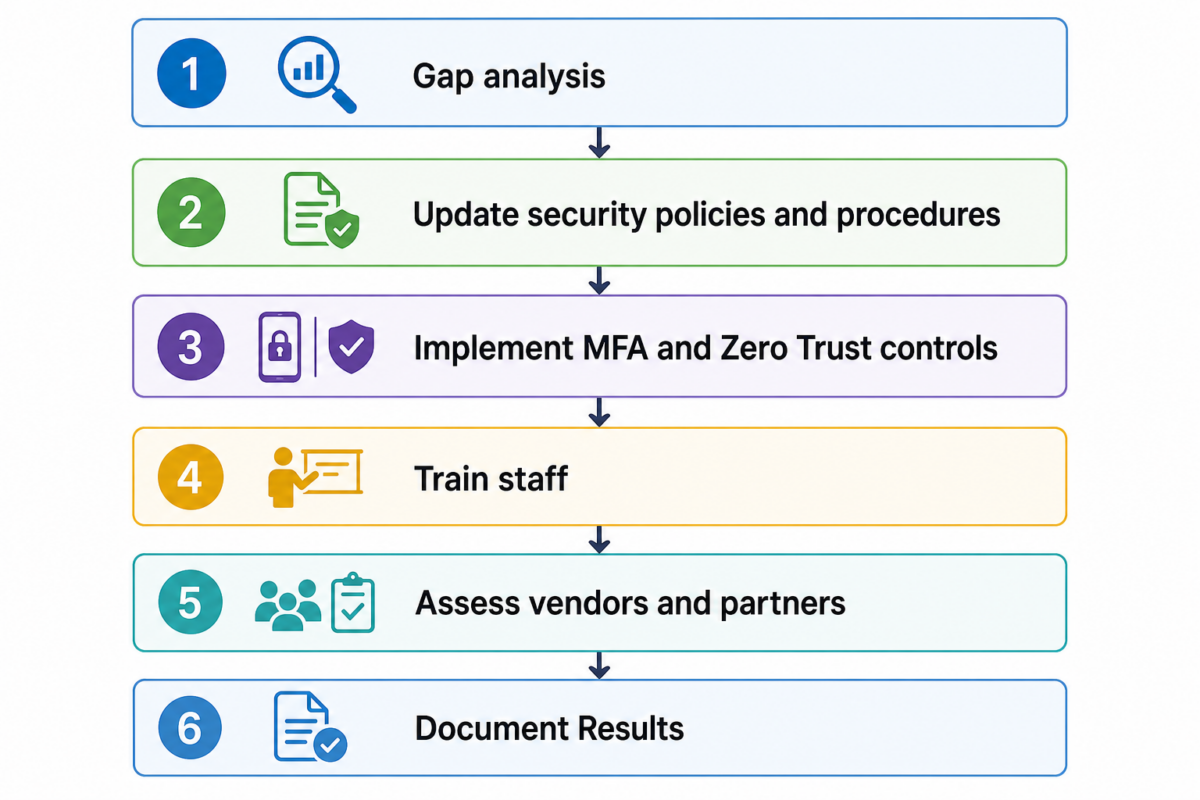
How to Achieve CJIS 6.0 Compliance
Getting compliant with CJIS 6.0 requires a structured approach:
- Conduct a gap analysis — Compare your current security controls against the CJIS 6.0 requirements to identify areas that need improvement.
- Update your security policies and procedures — Ensure your internal documentation reflects the new requirements.
- Implement MFA and Zero Trust controls — Upgrade authentication systems and review access control policies.
- Train your staff — CJIS requires security awareness training for all personnel with access to CJI.
- Assess your vendors and partners — Ensure any third-party providers handling CJI are also compliant.
- Document everything — Maintain thorough records of your compliance efforts for audits.
Final Thoughts
CJIS 6.0 represents a significant step forward in protecting criminal justice information against modern cyber threats. Whether you’re a law enforcement agency, a managed service provider, or a technology vendor, understanding and implementing the requirements of CJIS 6.0 is essential.
Staying compliant not only protects your organization — it protects the integrity of the criminal justice system and the privacy of the individuals whose data it holds.
